
Cycles Don’t End
We’ve never understood the use of end-to-end and policy lifecycle in the same contexts. If you look at the graphic below, the only way the lifecycle ends is if there’s no renewal. That doesn’t even seem like a suggestion one would want to imply, let alone a necessary end (if you’ll forgive the pun).
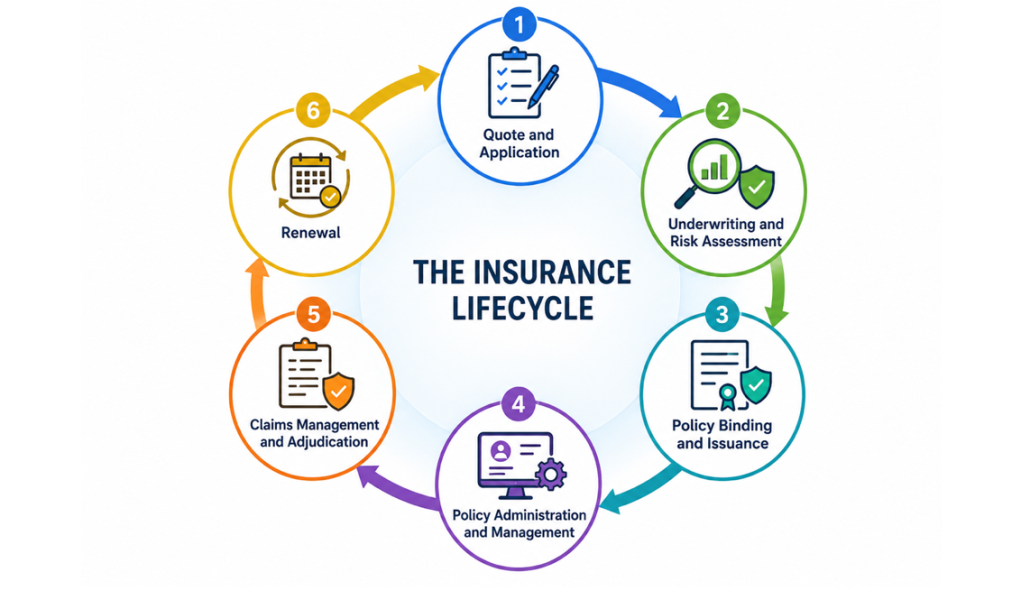
It seems to us that rather than ending the policy lifecycle, we should streamline it by reducing friction or administrative drag — automating processes, improving data flow, minimizing errors, improving accuracy, centralizing data and documents, and accelerating decision-making at every step in the cycle.
It Doesn’t Have to Be a Drag
Contemporary core-processing systems — likely powered by AI, automation, APIs, data prefills, and integrated platforms — reduce or eliminate drag with faster, more accurate data intake and digitization. AI can extract data from submissions, loss runs, photos, and documents in multiple formats and feed it into the system via APIs or RPA (robotic process automation), reducing manual keying and rework. Property intelligence tools provide on-demand COPE (construction, occupancy, protection, exposure) data, risk insights, and imagery that can cut application processing time by up to 80 percent and catch ineligible risks early.
Automated underwriting and decision-making can handle routine risk assessment, triage, and determine next best actions (workflow) that frees underwriters for complex cases. That shortens quote-to-bind cycles and reduces human error. Prefill and open integrations pull external data automatically, minimizing back-and-forth with brokers.
Connected modules like policy admin and rating engines further enhance workflows across the lifecycle, eliminating silos and redundant steps, enabling operational scaling without staff increases. They also improve claims management and efficiency by automating triage, incorporating photos, facilitating estimates, and resolving payment issues while reducing adjusters’ workloads.
The Cycle Remains Unbroken
To put it concisely, streamlining operations (reducing friction and drag) shifts effort from repetitive admin work to higher-value activities like nuanced risk analysis and policyholder retention. Such streamlining improves efficiency, increases productivity, and bolsters competitiveness.
If you’d like to learn more, we’d like to talk with you. In the meantime, please remember:
Cycles don’t end. If they did, they’d be finales.